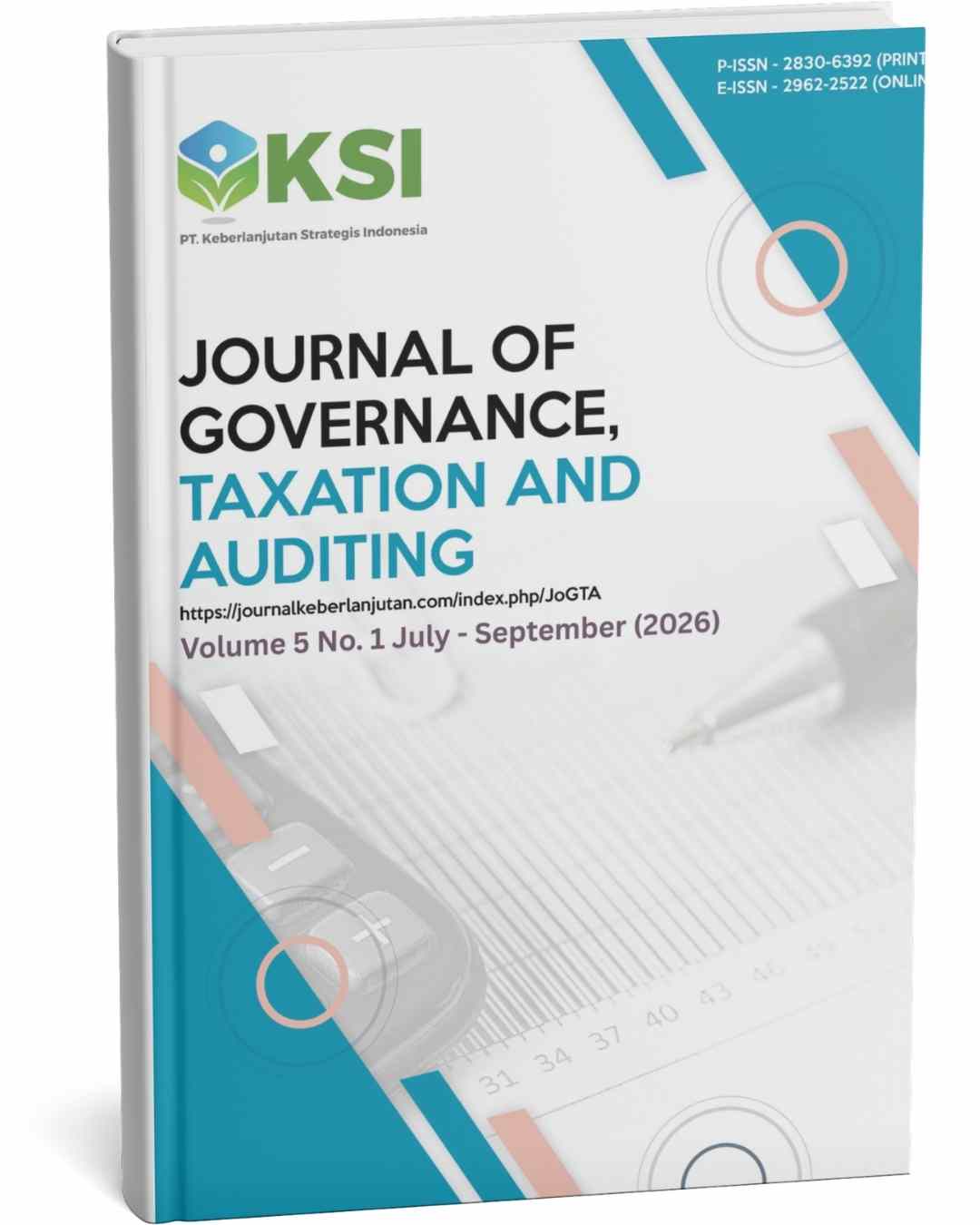
Sustainable Innovation Capability as a Mediator Between Intellectual Capital and Competitive Advantage: Evidence from Course and Training Institutions in Indonesia

DOI:
https://doi.org/10.38142/jogta.v5i1.2002Keywords:
Human Capital, Structural Capital, Relational Capital, Sustainable Innovation Capabilities, Competitive Advantage, Course And Training Institutions (LKP)Abstract
This study aims to examine the influence of human capital, structural capital, and relational capital on competitive advantage by positioning sustainable innovation capability as a mediating variable in Course and Training Institutions (LKP) in Indonesia. The approach used in this study is quantitative with AMOS-based Structural Equation Modeling (SEM) analysis techniques. Data were collected from 299 Course and Training Institutions (LKP) participating in the industry, business, and work-based resource improvement program (IDUKA) through a saturated sample/total sampling method. The analysis results show that human capital, structural capital, and relational capital have a significant effect on sustainable innovation capability and competitive advantage. In addition, sustainable innovation capability is also proven to significantly mediate the relationship between the three intellectual capital variables and competitive advantage. This finding emphasizes the importance of synergistic intellectual capital management to strengthen sustainable innovation capability as a strategy to gain competitive advantage in the non-formal education services sector. The novelty of this study lies in the integration of the Resource-Based View model and Dynamic Capability Theory to reveal the mediating mechanism of sustainable innovation capability in the context of Course and Training Institutions (LKP), which has never been studied empirically before.
References
Alghamdi, Omar A., & Agag, G. (2024). Competitive advantage: A longitudinal analysis of the roles of data-driven innovation capabilities, marketing agility, and market turbulence. Journal of Retailing and Consumer Services, 76, 103547. https://doi.org/10.1016/j.jretconser.2023.103547
Aljuboori, Z. M., Singh, H., Haddad, H., Al-Ramahi, N. M., & Ali, M. A. (2021). Intellectual Capital and Firm Performance Correlation: The Mediation Role of Innovation Capability in Malaysian Manufacturing SMEs Perspective. Sustainability, 14(1), 154. https://doi.org/10.3390/su14010154
Aman-Ullah, A., Mehmood, W., Amin, S., & Abbas, Y. A. (2022). Human capital and organizational performance: A moderation study through innovative leadership. Journal of Innovation & Knowledge, 7(4), 100261. https://doi.org/10.1016/j.jik.2022.100261
Aramburu, N., Sáenz, J., & Blanco, C. E. (2015). Structural capital, innovation capability, and company performance in technology-based Colombian firms. Cuadernos de Gestión, 15(1), 39–60. https://doi.org/10.5295/cdg.130427na
Azzahra, K. (2018). The Influence of Human Capital, Structural Capital and Relational Capital on the Performance of Corporations with Competitive Advantage as an Intervening Variable of Cooperation in South Tangerang. Economics and Accounting Journal, 1(1).
Ball, S. J. (2018). Commercializing education: profiting from reform! Journal of Education Policy, 33(5), 587–589. https://doi.org/10.1080/02680939.2018.1467599
Belmonte da Silva, R., Fernández Jardón, C. M., & Veiga Avila, L. (2021). Effects of Structural Intellectual Capital on The Innovation Capacity of Public Administration. Journal of Technology Management & Innovation, 16(3), 66–78. https://doi.org/10.4067/S0718-27242021000300066
Beltramino, N. S., García-Perez-de-Lema, D., & Valdez-Juárez, L. E. (2020). The structural capital, the innovation and the performance of the industrial SMES. Journal of Intellectual Capital, 21(6), 913–945. https://doi.org/10.1108/JIC-01-2019-0020
Bontis, N., Yaacob, M. R., Khalique, M., Ramayah, T., & Qureshi, I. A. (2020). Impact of Intellectual Capital on Innovation in Pharmaceutical Manufacturing SMEs in Pakistan. International Journal of Learning and Intellectual Capital, 17(1), 1. https://doi.org/10.1504/IJLIC.2020.10023755
Bozbura, F. T. (2004). Measurement and application of intellectual capital in Turkey. The Learning Organization, 11(4/5), 357–367. https://doi.org/10.1108/09696470410538251
Chamsuk, W., Fongsuwan, W., & Takala, J. (2017). The Effects of R&D and Innovation Capabilities on the Thai Automotive Industry Part’s Competitive Advantage: A SEM Approach. Management and Production Engineering Review, 8(1), 101–112. https://doi.org/10.1515/mper-2017-0011
Chatterjee, S., Chaudhuri, R., Thrassou, A., & Sakka, G. (2022). Impact of firm’s intellectual capital on firm performance: a study of Indian firms and the moderating effects of age and gender. Journal of Intellectual Capital, 23(1), 103–126. https://doi.org/10.1108/JIC-12-2020-0378
Chen, S.-H. (2016). The Influencing Factors of Enterprise Sustainable Innovation: An Empirical Study. Sustainability, 8(5), 425. https://doi.org/10.3390/su8050425
Dewi, R. S., Alhabsy, T., Arifin, Z., & Abdillah, Y. (2019). Does Intellectual Capital Improve the Performance of SME’s? WACANA, Jurnal Sosial Dan Humaniora, 22(2).
Diebolt, C., & Hippe, R. (2019). The long-run impact of human capital on innovation and economic development in the regions of Europe. Applied Economics, 51(5), 542–563. https://doi.org/10.1080/00036846.2018.1495820
Dzenopoljac, V., Yaacoub, C., Elkanj, N., & Bontis, N. (2017). Impact of intellectual capital on corporate performance: evidence from the Arab region. Journal of Intellectual Capital, 18(4), 884–903. https://doi.org/10.1108/JIC-01-2017-0014
Fonseca, T., de Faria, P., & Lima, F. (2019). Human capital and innovation: the importance of the optimal organizational task structure. Research Policy, 48(3), 616–627. https://doi.org/10.1016/j.respol.2018.10.010
García-Merino, J. D., García-Zambrano, L., & Rodriguez-Castellanos, A. (2014a). Impact of Relational Capital on Business Value. Journal of Information & Knowledge Management, 13(01), 1450002. https://doi.org/10.1142/S0219649214500026
García-Merino, J. D., García-Zambrano, L., & Rodriguez-Castellanos, A. (2014b). Impact of relational capital on business value. Journal of Information and Knowledge Management, 13(1), 1–8. https://doi.org/10.1142/S0219649214500026
Gogan, M.-L., Duran, D. C., & Draghici, A. (2014). The Impact of Relational Capital on Competitive Advantage of the Organization. Network Intelligence Studies, 2(4).
Hermundsdottir, F., & Aspelund, A. (2021). Sustainability innovations and firm competitiveness: A review. Journal of Cleaner Production, 280, 124715. https://doi.org/10.1016/j.jclepro.2020.124715
Huang, C. C., Luther, R., & Tayles, M. (2007). An evidence‐based taxonomy of intellectual capital. Journal of Intellectual Capital, 8(3), 386–408. https://doi.org/10.1108/14691930710774830
Hwang, W.-S., Choi, H., & Shin, J. (2020). A mediating role of innovation capability between entrepreneurial competencies and competitive advantage. Technology Analysis & Strategic Management, 32(1), 1–14. https://doi.org/10.1080/09537325.2019.1632430
Iazzolino, G., Chiappetta, F., & Chiappetta, S. (2018). Relational Capital and Financial Performance: an empirical analysis on a sample of Italian firms. Problems and Perspectives in Management, 16(1), 245–258. https://doi.org/10.21511/ppm.16(1).2018.24
Indrawati, S. M., & Kuncoro, A. (2021). Improving Competitiveness Through Vocational and Higher Education: Indonesia’s Vision for Human Capital Development In 2019–2024. Bulletin of Indonesian Economic Studies, 57(1), 29–59. https://doi.org/10.1080/00074918.2021.1909692
Khan, E. A., & Quaddus, M. (2018). Dimensions of human capital and firm performance: Micro-firm context. IIMB Management Review, 30(3), 229–241. https://doi.org/10.1016/j.iimb.2018.05.004
Kuncoro, W., & Suriani, W. O. (2018). Achieving sustainable competitive advantage through product innovation and market driving. Asia Pacific Management Review, 23(3), 186–192. https://doi.org/10.1016/j.apmrv.2017.07.006
Liu, C.-H., Chang, A. Y.-P., & Fang, Y.-P. (2019a). Network activities are critical sources of creating capability and competitive advantage. Management Decision, 58(3), 544–568. https://doi.org/10.1108/MD-08-2017-0733
Liu, C.-H., Chang, A. Y.-P., & Fang, Y.-P. (2019b). Network activities are critical sources of creating capability and competitive advantage. Management Decision, 58(3), 544–568. https://doi.org/10.1108/MD-08-2017-0733
Mardatillah, A., Raharja, S. J., Hermanto, B., & Herawaty, T. (2020). Human Capital and Partnership to Achieve Sustainable Competitive Advantage in Micro and Small Businesses. International Journal of Supply Chain Management, 9(5), 1415–1424.
Maritan, C. A., & Peteraf, M. (2018). Competitive Advantage. In The Palgrave Encyclopedia of Strategic Management (pp. 298–300). Palgrave Macmillan UK. https://doi.org/10.1057/978-1-137-00772-8_465
Mendoza-Silva, A. (2021). Innovation capability: a systematic literature review. European Journal of Innovation Management, 24(3), 707–734. https://doi.org/10.1108/EJIM-09-2019-0263
Obeidat, B. Y., Tarhini, A., Ra', N. A., Masa', ed, deh, N. A., & Aqqad, N. O. (2017). The impact of intellectual capital on innovation via the mediating role of knowledge management: a structural equation modeling approach. International Journal of Knowledge Management Studies, 8(3/4), 273. https://doi.org/10.1504/IJKMS.2017.087071
Ozturk, S., & Gerekan, B. (2021). The Effect of Board Structure on Sustainable Innovation Capability: A Research on Turkey. Hacettepe Üniversitesi İktisadi ve İdari Bilimler Fakültesi Dergisi, 39(1), 103–120. https://doi.org/10.17065/huniibf.740563
Pangidoan, O. T., & Nawangsari, L. C. (2022). effect of human capital, structural capital, relational capital and innovative behavior in organizational performance of PT. PLN (Persero) Company, Bekasi. Linguistics and Culture Review, 6, 773–796. https://doi.org/10.21744/lingcure.v6nS1.2153
Paulus, A. L. (2017). Human Capital dan Keunggulan Bersaing Ritel Minimarket: Strategi Sebagai Pemediasi. Management Insight Journal Ilmiah Manajemen, 12(1), 1–11. https://doi.org/10.33369/insight.12.1.1-11
Paulus, A. L., & Murdapa, P. S. (2017). The Utilization of Resource-Based View Theory on Minimarket Retail: Its Implication toward Strategy and Competitive Advantage. SSRN Electronic Journal. https://doi.org/10.2139/ssrn.2894121
Roos, J., Roos, G., Dragonetti, N. C., & Edvinsson, L. (1997). Intellectual Capital: Navigating the New Business Landscape. MACMILLAN PRESS Ltd.
Rumerung, J., Saerang, D. P. E., Mananeke, L., & Lengkong, V. P. K. (2019). Effects of Human Capital, Structural Capital and Relations Capital on Business Performance with Intervening Competitiveness in the Meetings, Incentives, Conferences and Exhibitions (MICE) Industry in North Sulawesi Province. Journal of Applied Economic Sciences, 14(4), 1191.
Ryu, D., Baek, K. H., & Yoon, J. (2021). Open Innovation with Relational Capital, Technological Innovation Capital, and International Performance in SMEs. Sustainability, 13(6), 3418. https://doi.org/10.3390/su13063418
Samson, D., Gloet, M., & Singh, P. (2017). Systematic Innovation Capability: Evidence From Case Studies and a Large Survey. International Journal of Innovation Management, 21(07), 1750058. https://doi.org/10.1142/S136391961750058X
Shou, Y., Shao, J., & Chen, A. (2017). Relational resources and performance of Chinese third-party logistics providers. International Journal of Physical Distribution & Logistics Management, 47(9), 864–883. https://doi.org/10.1108/IJPDLM-09-2016-0271
Sigalas, C., & Pekka Economou, V. (2013). Revisiting the concept of competitive advantage. Journal of Strategy and Management, 6(1), 61–80. https://doi.org/10.1108/17554251311296567
Smriti, N., & Das, N. (2018). The impact of intellectual capital on firm performance: a study of Indian firms listed in COSPI. Journal of Intellectual Capital, 19(5), 935–964. https://doi.org/10.1108/JIC-11-2017-0156
Sulistyo, H., & Ayuni, S. (2019). Competitive advantages of SMEs: The roles of innovation capability, entrepreneurial orientation, and social capital. Contaduría y Administración, 65(1), 156. https://doi.org/10.22201/fca.24488410e.2020.1983
Tiengtavaj, S., Phimonsathienand, T., & Fongsuwan, W. (2017). Ensuring Competitive Advantage through Innovation Capability and Clustering in the Thai Automotive Parts Molding Industry: A SEM Approach. Management and Production Engineering Review, 8(1), 89–100. https://doi.org/10.1515/mper-2017-0010
Udayana, I. B. N., Farida, N., Lukitaningsih, A., Tjahjono, H. K., & Nuryakin. (2021). The important role of customer bonding capability to increase marketing performance in small and medium enterprises. Cogent Business & Management, 8(1). https://doi.org/10.1080/23311975.2021.1932239
Vasiliev, A. (2022). Designing the University Competitiveness Management System: Functions, Levels, Objects. International Journal of Instruction, 15(4), 1053–1070. https://doi.org/10.29333/iji.2022.15456a
Wang, W., Zhang, Y., & Chen, S. (2023). The development of the sustainable innovation capabilities construct using grounded theory: evidence from Chinese equipment manufacturers. European Journal of Innovation Management. https://doi.org/10.1108/EJIM-10-2022-0546
Wongsansukcharoen, J., & Thaweepaiboonwong, J. (2023). Effect of innovations in human resource practices, innovation capabilities, and competitive advantage on small and medium enterprises’ performance in Thailand. European Research on Management and Business Economics, 29(1), 100210. https://doi.org/10.1016/j.iedeen.2022.100210
Yaseen, S. G., Dajani, D., & Hasan, Y. (2016). The impact of intellectual capital on the competitive advantage: Applied study in Jordanian telecommunication companies. Computers in Human Behavior, 62, 168–175. https://doi.org/10.1016/j.chb.2016.03.075
Yu, C., Zhang, Z., Lin, C., & Wu, Y. (2017). Knowledge Creation Process and Sustainable Competitive Advantage: The Role of Technological Innovation Capabilities. Sustainability, 9(12), 2280. https://doi.org/10.3390/su9122280
Downloads
Published
Issue
Section
License
Copyright (c) 2026 Teddy Chandra, Amirudin M Amin, Suhermin

This work is licensed under a Creative Commons Attribution-NonCommercial 4.0 International License.
Creative Commons Attribution-NonCommercial 4.0 International License.